
Why how your child eats matters just as much as what they eat.
Walk down almost any grocery store baby food aisle, and you'll find shelves filled with colorful, convenient food pouches. They're easy to pack, relatively mess-free, and a lifesaver for busy parents on the go!
But as pediatric speech and occupational therapists, we want parents to understand something important: Learning to eat is about much more than getting food into little tummies.
While food pouches can certainly have their place, relying on them too frequently may mean children miss valuable opportunities to develop important feeding and motor skills.
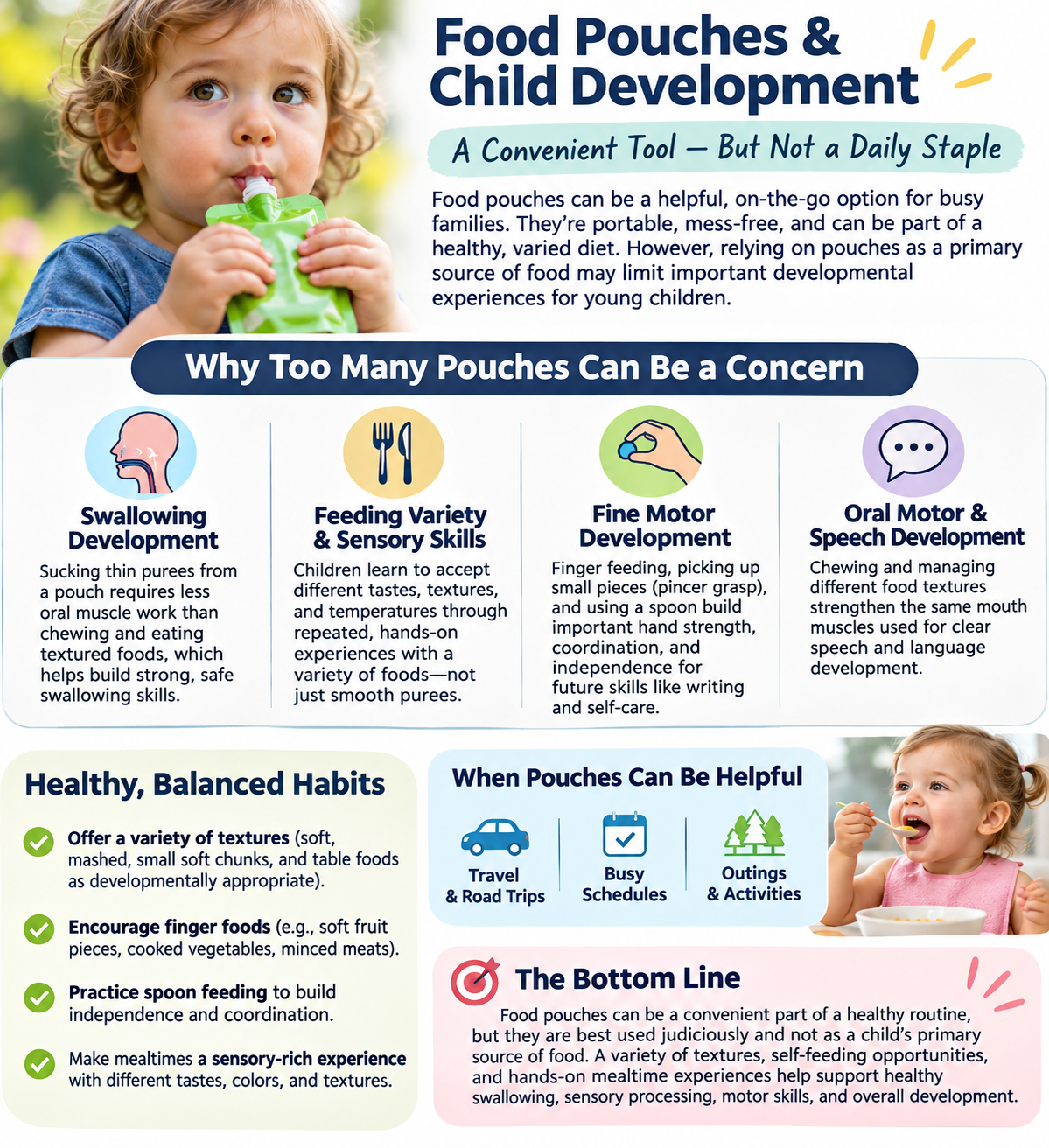
Feeding Is a Developmental Learning Experience
When babies and toddlers eat from a spoon, pick up soft foods with their fingers, and explore different textures, they're developing skills that extend far beyond mealtime.
1. Oral-Motor and Swallowing Development
Eating a variety of developmentally appropriate food textures helps children learn to move food around their mouths, use their tongues effectively, develop chewing skills, and coordinate the movements necessary for safe, efficient eating.
Sucking smooth purees directly from a pouch provides a much more limited oral-motor experience than eating foods that require tongue movement, chewing, and manipulation.
2. Sensory Development and Food Acceptance
Babies learn about food through all their senses. Touching, smelling, seeing, and tasting foods with different textures helps them become comfortable with new eating experiences.
When children primarily consume smooth purees from pouches, they have fewer opportunities to explore lumps, soft solids, and other textures. This may contribute to difficulty accepting more advanced food textures, particularly in children who are already sensitive to sensory experiences.
3. Fine Motor Skills and Hand-Eye Coordination
Mealtime is a wonderful opportunity to develop little hands!
Picking up small pieces of soft food encourages the development of the pincer grasp, using the thumb and index finger together. Learning to hold and use a spoon builds coordination, motor planning, and independence.
When children primarily suck food from pouches, many of these valuable learning opportunities are missed.
4. Independence and Self-Feeding Skills
Learning to eat independently takes practice! Scooping food, bringing a spoon to the mouth, grasping finger foods, and managing spills all help children develop confidence and independence.
Yes, it can be messy. But that mess is often part of the learning process!
So, Should Parents Avoid Food Pouches?
Absolutely not! Food pouches can be a convenient option for travel, outings, or those hectic days when sitting down for a meal just isn't practical.
The key is moderation.
Here are a few simple ways to support healthy feeding development:
Offer a variety of age-appropriate textures as your child's feeding skills develop.
Encourage supervised finger feeding and spoon use.
Let your child touch, explore, and get a little messy with food.
When using pouch foods at home, consider squeezing the puree into a bowl and offering it with a spoon.
Whenever possible, make meals an opportunity to sit together, interact, and practice eating skills.
The Bottom Line
Food pouches are a tool for convenience, not a replacement for learning to eat.
Children develop feeding skills through experience and practice. Providing opportunities to explore food, develop chewing skills, and learn to self-feed helps build a strong foundation for successful eating.
At Theracare Outpatient Therapy Services, our speech and occupational therapists help children who experience feeding challenges, including difficulty transitioning to textured foods, limited food acceptance, sensory feeding difficulties, and oral-motor skill delays.
If your child struggles with advancing food textures, chewing, or independent feeding, our team is here to help!
Every child develops at their own pace. Always offer foods appropriate for your child's developmental abilities, supervise eating, and follow guidance from your pediatrician or feeding specialist when swallowing safety is a concern.